 Completed
Multi-Agent Aerial Swarm Coordination
Event-driven coordination protocol for autonomous drone swarms
As an Undergraduate Research Assistant at the Communication Systems and Networks Lab, I collaborated on developing cutting-edge coordination protocols for multi-agent aerial swarms. This project focused on enabling autonomous drones to work together seamlessly in complex formations and dynamic environments.
System Architecture
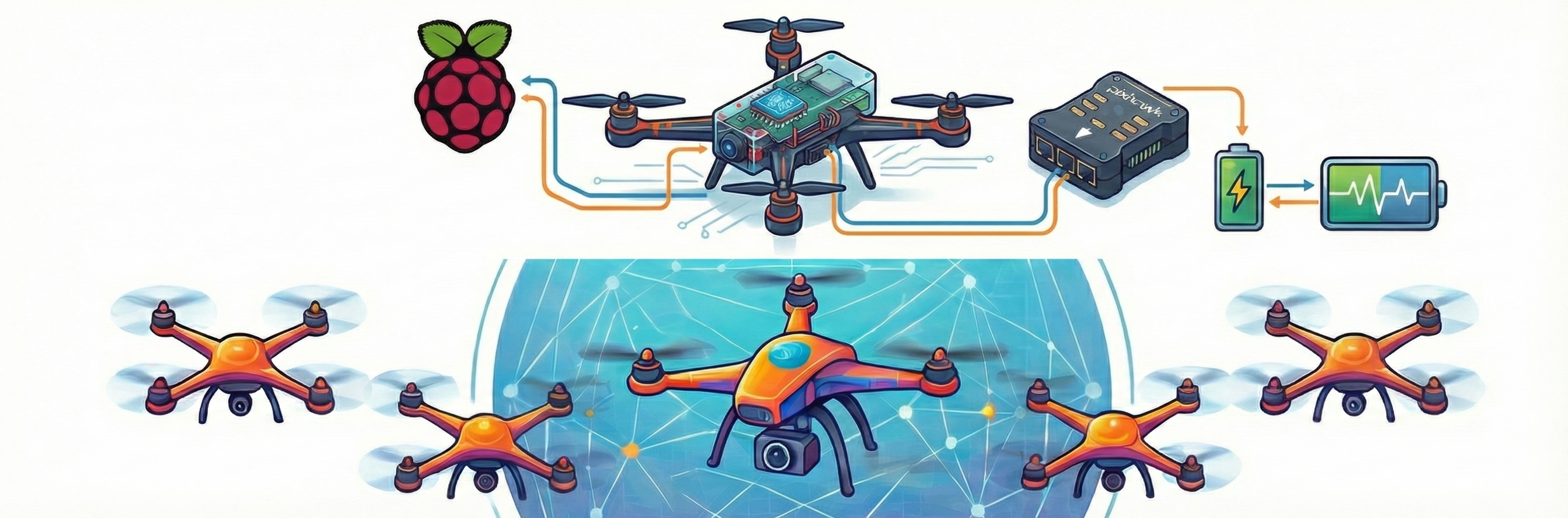
The core of this project involved implementing an event-driven coordination protocol on Raspberry Pi companion computers integrated with Pixhawk/ArduPilot flight controllers. This architecture provided the computational power needed for real-time decision-making while maintaining the reliability of proven flight control systems.
Formation Control Design
I designed and optimized leader-follower formation control algorithms supporting three distinct formation types: flock, line, and helical configurations. A key achievement was enabling dynamic reconfiguration between formations with under 2 minutes of switching latency, allowing the swarm to adapt to changing mission requirements in near real-time.
The formation control system utilized distributed consensus algorithms where follower agents maintained relative positions to the leader while accounting for inter-agent collision avoidance. Each formation type was parameterized to allow for scalable swarm sizes and adjustable spacing constraints.
Fault-Tolerant Communication Stack
One of the most challenging aspects was engineering a robust mesh networking stack to ensure reliable communication between agents. The system leveraged IEEE 802.11 for wireless connectivity, implementing both UDP for time-critical control messages and TCP for reliable data transfer. Integration with the MAVLink protocol enabled standardized communication with the flight controllers.
The fault-tolerant design included automatic route discovery and healing mechanisms, ensuring that the loss of individual communication links wouldn’t compromise the entire swarm’s coordination. Through careful optimization, we achieved communication latencies under 100ms, critical for maintaining stable formation control.
Impact and Applications
This research has applications in disaster response, agricultural monitoring, search and rescue operations, and coordinated surveillance. The event-driven architecture ensures efficient resource utilization while the dynamic reconfiguration capability allows swarms to adapt to evolving mission parameters without returning to base.
Duration: September 2022 - July 2023
Institution: National University of Sciences & Technology, Pakistan
Lab: Communication Systems and Networks Lab